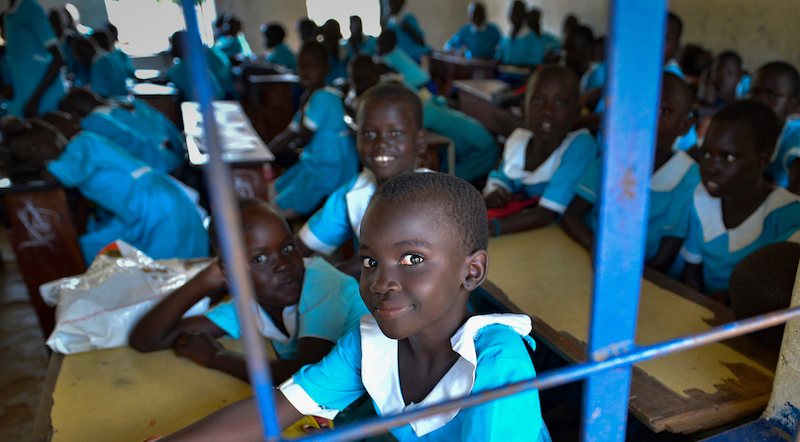
The Digitally Integrated Daily Instructor (D.I.D.I.) is an offline AI tutor that gives students access to curriculum-aligned learning resources without WiFi. It is now used in schools in South Sudan and Malawi and is expanding to Pakistan, Bangladesh and Tanzania.
Mateo Acosta-Rubio, founder of LetAllGirls, the nonprofit behind DIDI, said the project began with one girl’s determination to educate women in her country.
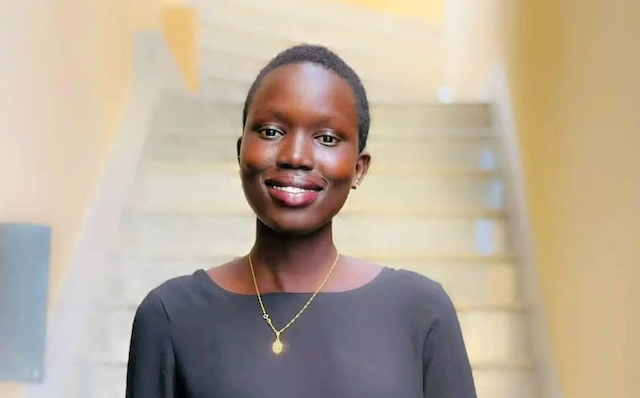
“Her name was Didi,” Mateo said. “We met at a pitch event at Babson College. She wanted to help women in her native South Sudan, where more than half of girls marry before 18 and are often denied the right to learn. Didi was the first girl in her community to study abroad – fearless and brilliant. Even with a thick accent, she used words I had to Google.”
Inspired by Didi, Mateo offered to help and began working to turn her vision into reality. Less than a month later, she died unexpectedly from a brain aneurysm at age 18.
It was a huge shock for the community,” Mateo said. “Everyone wanted to help.”
Overnight, nearly 200 students donated almost $6,000 to a GoFundMe campaign Didi and Mateo created to expand education in developing countries.
“I realized this was a chance to honor her work and see it grow,” Mateo said.
The project has grown to a team of four and 14 student volunteers , working closely with Didi’s family in South Sudan.
Solving education’s infrastructure problem in Africa
South Sudan, a war-torn country since its independence 13 years ago, presents extreme challenges for education. UN reports indicate thousands of civilians are victims of killings, abductions, and sexual violence every year, often linked to ethnic militias.
Until now, Mateo didn’t have a chance to visit South Sudan in person to explore how his solution works.
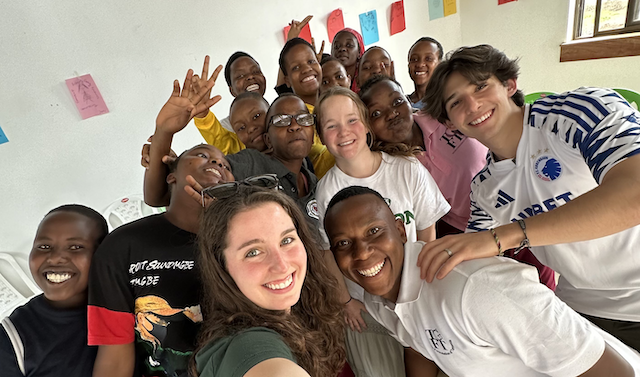
He first traveled to Africa in 2024, teaching entrepreneurship in Tanzania, where he saw firsthand the potential of AI in education. “Students there had incredible curiosity,” Mateo said. “Just asking basic questions about the human body, they lit up when the AI provided answers. It gave me goosebumps.”
The team realized that lack of infrastructure is the primary barrier to learning. “There are plenty of educational resources, but WiFi, electricity, and teacher availability are the bottlenecks,” Mateo said.
DIDI addresses this by providing AI-powered lessons offline, using minimal power and a device that acts like a local WiFi hub, supporting up to 25 connected devices.
The nonprofit has kept costs low, producing devices for under $300 each at scale, and has partnered with local schools to ensure effective implementation.
Can AI help close Africa’s gender gap?
The AI tutor uses regional curricula and local partners, similar to Khan Academy and TED-Ed. In Malawi, for example, DIDI collaborates with a platform created by Malawian teachers who teach math in a local context.
“Two plus two is always four, but the thought process is different,” Mateo said. “When it’s explained by someone from Malawi who learned the same arithmetic in elementary school, it becomes much easier for students to grasp the concepts.”
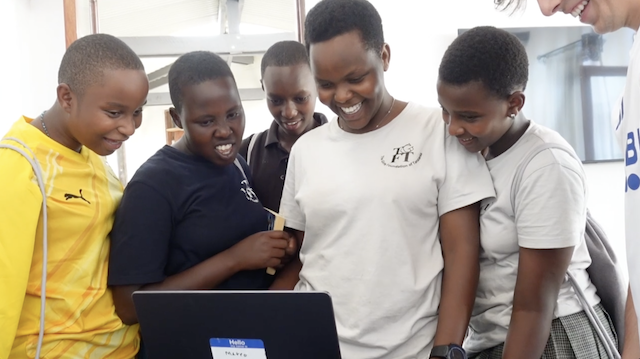
Mateo described the impact of AI on girls in South Sudan. “Many feel empowered to explore their curiosity without fear of judgment. In classrooms where girls are often marginalized, DIDI gives them a personal tutor who believes in their ability to learn.”
According to a recent World Bank study, AI has the potential to close the gender gap. During a six-week program in Benin City, Nigeria, students using the AI teacher ChatGPT-4 significantly improved their test results.
Girls, who typically fall behind in Sub-Saharan Africa, caught up more than their peers, closing the gender gap.
However, the program faced major challenges due to limited infrastructure, including unreliable electricity and Wi-Fi.
“There’s huge potential for AI to transform the way we reach these audiences and educate them,” Mateo said. “The only thing holding us back is infrastructure.”
Beyond Africa, DIDI is expanding to South Asia, with plans to adapt to other underserved regions.