Canada: A glasses-free 3D display CubicScreen
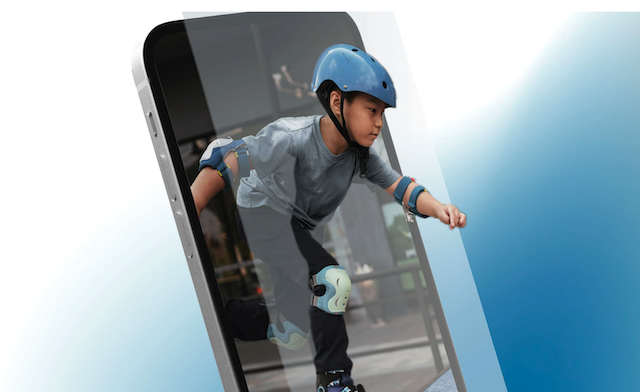
CubicScreen transforms the iPhone into a glasses-free 3D display by combining a thin optical screen protector with an intuitive spatial media app. At its core is an adaptive 3D model that adjusts stereoscopic geometry in real time based on the content, the viewer, and viewing conditions. The approach departs from the one-size-fits-all assumptions that have long limited traditional 3D technology. Built on a scientific breakthrough in stereoscopic geometry, CubicScreen is designed for practical, everyday use.
China: An’An panda cub robot

Developed by Mind with Heart Robotics, the biomimetic An’An panda cub robot is designed for elder care and cognitive support, including dementia and autism-related use cases. Early trials in Hong Kong showed mood improvements in older adults with mild cognitive impairment or dementia, suggesting a pathway toward regulatory approval. An’An pairs with an app to provide medication reminders and daily prompts, while its AI system learns users’ voices and touch patterns to personalize interactions over time. Handcrafted with wool and sheepskin and equipped with full-body touch sensors, the robot delivers lifelike responses.
France: 3D medical imaging platform Eonis Vision
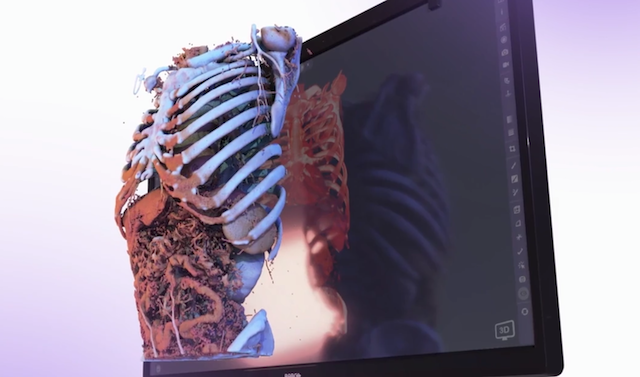
Eonis Vision by Avatar Medical and Barco, is a clinical-grade, glasses-free 3D medical imaging platform designed to transform how patients engage with their care. The system allows patients and surgeons to view and interact with realistic 3D models of a patient’s own anatomy during consultations, replacing traditional flat radiology images and supporting shared decision-making. The platform combines Avatar Medical’s FDA-cleared 3D imaging software, Barco’s glasses-free 3D display and Dell’s workstation technology, aiming to make complex medical information clearer.
Hong Kong: Point Fit’s non-invasive skin patch
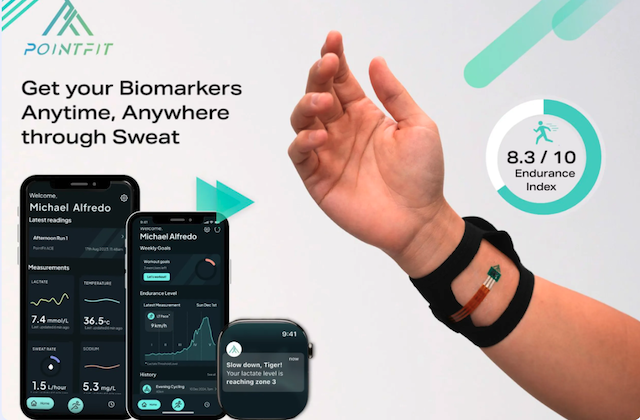
Point Fit’s non-invasive skin patch analyzes sweat biomarkers, including lactate, glucose, electrolytes, and cortisol, to deliver real-time health insights. Unlike blood or urine tests, sweat enables continuous monitoring, while offering richer, exercise-ready data than saliva. Using patented Evaporative Dermal Biosensing, the ultra-thin nanomembrane patch captures precise biomarker readings directly from the skin. This wearable patch offers a pain-free, discreet, and convenient solution for athletes, patients, and health enthusiasts.
India: A countertop robo-chef Nosh
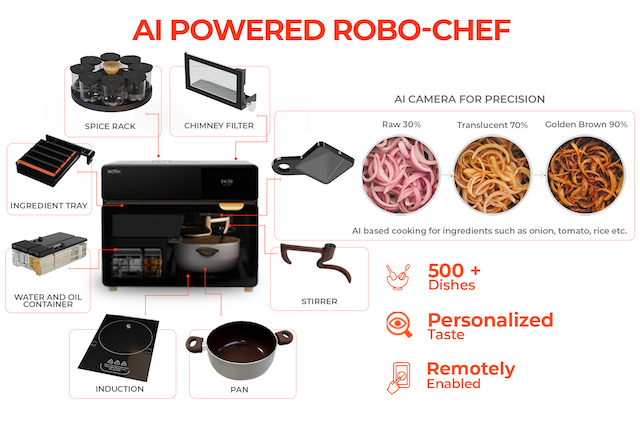
Nosh is a countertop robo-chef that uses artificial intelligence and food science to automatically prepare more than 500 dishes from global cuisines, tailored to individual taste preferences. Equipped with a built-in camera, the system monitors ingredients in real time to determine doneness and move through each cooking step, while a mobile app allows users to start meals remotely. The company says the device has been six years in development and is now used by more than 1,000 households, which have prepared over 25,000 meals since its launch last year.
Israel: NeuroVoice voice activity detection chip
Voice detection is the “final frontier” for IoT and a step toward a truly connected world. At CES, Polyn Technology showcased its NeuroVoice voice activity detection chip, an always-on, internet-free device that detects speech even in noisy environments. Consuming only microwatts of power and operating with microsecond-scale latency, the NASP chip runs neural-network inference directly in the analog domain. Designed for battery-powered, always-listening devices, it could power everyday objects ranging from kettles to car wheels.
Italy: Healthcare-focused humanoid robot RoBee M
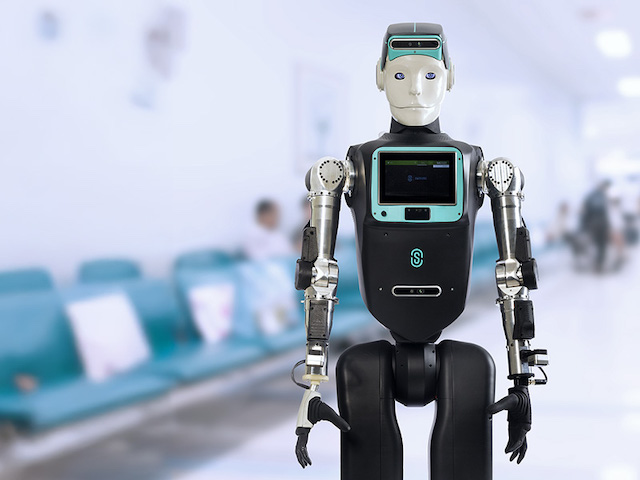
Oversonic Robotics, Italy’s first maker of humanoid robots with cognitive AI, unveiled its healthcare-focused model RoBee M at CES. Designed for hospitals, rehabilitation centers, and elderly care facilities, the robot combines autonomous mobility, natural interaction, and data-driven intelligence, and can be deployed without technical training. Built with safety as a priority, RoBee M can operate reliably even when pushed or obstructed and is already being tested in hospital settings. Oversonic’s industrial model, RoBee R, is already in use in the U.S., including by semiconductor leader STMicroelectronics.
Japan: The Orphe smart Insole
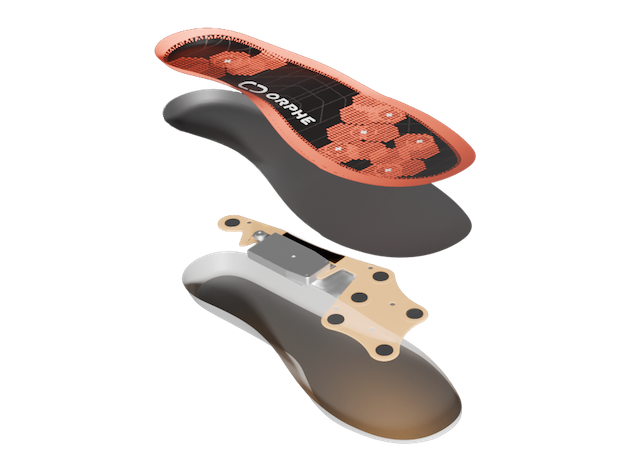
The Orphe Insole combines six pressure sensors and a 6-axis motion unit in an ultra-thin, wireless-charging design that delivers more than 24 hours of continuous use without sacrificing comfort. It provides dual analysis with algorithm-based gait assessment and machine-learning motion recognition on the device, offering lab-quality biomechanical data in real-world settings. The system tracks gait patterns, weight distribution, and balance, with applications in healthcare, rehabilitation, sports science, ergonomics, and preventive care.
Korea: AI-powered EdTech platform Chalk 4.0
Education technology company First Habit won the startup pitching competition at the Global Innovation Forum 2026 at CES, showcasing its AI-powered platform Chalk 4.0. Using a proprietary Visual LLM, Chalk enables interactive, dialogue-based learning with a Visual Chatbot, 3D animations, and multimodal interactions. Trials have validated its impact. In 2024 beta tests in Korea and Boston, it achieved a 76.4 percent self-directed learning completion rate, five times the industry average. In 2025 blind tests, students using Chalk outperformed peers at top-tier academies by 30 to 40 percent.
Netherlands: Beephonix acoustic recognition technology
Beephonix, a spin-off from Radboud University Nijmegen, showcased its acoustic recognition technology at CES alongside Absolute Audio Labs. The company’s system, designed to help people with hearing impairments, uses 151 microphones to detect and track sound in real time. Inspired by the hearing mechanisms of bees, it combines beamforming, AI signal processing, and classification algorithms to follow conversations more effectively. Beyond personal hearing assistance, Beephonix is also exploring applications in battlefield drone detection.
Poland: Orchestra, the AI-enabled edge orchestration platform
Orchestra Platform is a unified orchestration system designed to simplify and secure Edge AI and IoT operations at scale. As industries move from pilot projects to full production across factories, fleets, infrastructure, and smart cities, Orchestra helps organizations maintain visibility, performance, and control in challenging edge environments. The platform uses a single technology stack to provide consistency and automation across diverse deployments, from industrial sensors and smart retail systems to AI-powered reverse vending machines in city centers.
Switzerland: Ultra-thin solid-state lithium-ion batteries BTRY
BTRY ultra-thin solid-state lithium-ion batteries are designed for next-generation electronics where size, safety, and durability are critical. Their thin-film cells target applications such as smart labels, high-temperature industrial sensors, MedTech devices, and compact wearables—areas where conventional lithium-ion batteries often fail due to heat sensitivity or safety risks. Using solid-state manufacturing techniques adapted from semiconductor processing, BTRY eliminates the liquid electrolyte, making the batteries non-flammable and as thin as 0.1 millimeters. Last year, the company raised $5.7 million in a seed round to scale from laboratory fabrication to industrial roll-to-roll production.