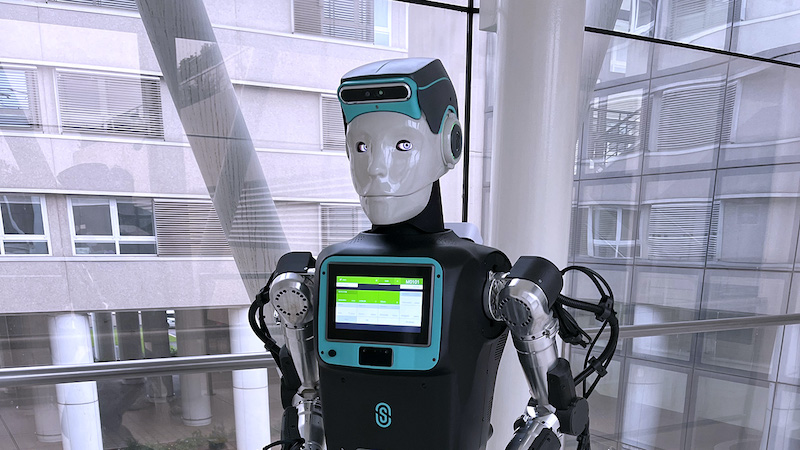
RoBee M, Oversonic’s healthcare-focused humanoid robot. Credit: Oversonic

Italian Robotics Firm Oversonic Opens LA Hub, Expands U.S. Reach via NantWorks

Oversonic Robotics, an Italian developer of cognitive humanoid robotics, has opened a 5,000-square-foot office in Los Angeles to support its expansion into the U.S. market. The site will serve as a hub for medical robotics development and national growth.

Oversonic’s move to establish a U.S. office coincides with a strategic partnership with NantWorks, a U.S. company with operations spanning healthcare and aerospace.

The announcement was made during the inaugural U.S.-Saudi Biotech Alliance Summit, held alongside the J.P. Morgan Healthcare Conference in San Francisco.

The Los Angeles location is intended to support the development of robotic platforms for hospitals and healthcare facilities, as well as coordinate Oversonic’s broader growth across the U.S. through partnerships and industrial alliances.

“Within a few months, we will be able to bring the first humanoids into U.S. clinics, where we will begin clinical trials and test the machines through direct interaction with patients,” said Paolo Denti, Oversonic’s chief executive officer.

Through its collaboration with NantWorks, launched by South Africa-born physician and biotech entrepreneur Dr. Patrick Soon-Shiong, Oversonic plans to accelerate research and development in medical and aerospace applications.

Subscription Form (#3)

Stay in the loop!

Take advantage of our immigrant tech community updates and insights in your inbox.

“This technological alliance with Dr. Patrick Soon-Shiong is also based on the joint development and shared use of advanced intellectual property,” said Fabio Puglia, Oversonic’s chairman.

In healthcare, the companies will focus on building safe and reliable humanoid robots for clinical settings.

In aerospace, the partnership will explore the use of Oversonic’s robotic platforms in space environments, including applications tied to lunar exploration and infrastructure support. Initial efforts are expected to focus on projects related to the lunar south pole and the Lunar Gateway orbital station.


Leave a Reply
You May Also Like
Credit: Shutterstock

Revisit the Pivot: How international startups can “make lemonade” out of their failures in America

Many tech companies are moving to the U.S. after enjoying success in their local European, Asian, or LatAm markets. But the American reality turns out to be different than expected. Products, approaches, and sometimes business concepts that worked well at home often fail in the U.S. After pouring resources into the world’s most competitive market, many leave disappointed. But there’s a way for them to change this. Star entrepreneur Mike Burtov, who has helped multiple startups grow, recommends immigrant founders to “make lemonade out of lemons” and embrace the pivot.
Credit: Shutterstock

3 Tips to help founders build productive bonds with mentors

Great mentorship is often a game-changer for international founders launching a new business in unfamiliar terrain. Whether you are looking for an expert in your industry or someone who appreciates the nuances of your immigrant background, you need the right strategy. Katja Wald, an expert in coaching programs for entrepreneurs, shares three tips for building exceptional synergy with a mentor.
Credit: Shutterstock

South Korean Startups in the U.S.: Finding Life Beyond the Valley

For many Korean startups, securing funding and gaining traction in the U.S. is a major milestone, often seen as a sign of success back home. Like many international companies, Korean tech entrepreneurs have long viewed Silicon Valley as their ultimate ambition. But some investors argue that New York City might offer new opportunities for Korean founders.