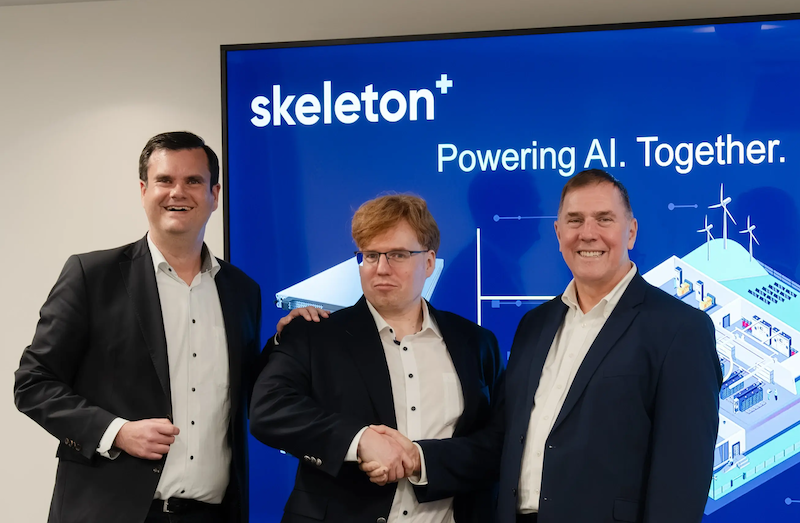
Tallinn-based energy storage company Skeleton Technologies has secured an investment led by Siemens that values it at more than $1 billion, as it expands U.S. manufacturing to address the power demands of AI data centers.
The financing will support manufacturing and research in Silicon Valley. Skeleton did not disclose the exact amount, describing it as a nine figure round.
Separately, the company outlined plans to invest more than $200 million in operational expansion and R&D in the U.S.
The deal also gives Siemens exclusive rights to sell and scale Skeleton’s products in the global data center market.
Siemens plans to integrate the technology into its electrical infrastructure portfolio, giving Skeleton a commercial partner that says it already works with nine of the world’s 10 largest data center providers.
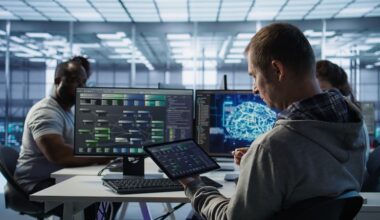
Skeleton targets a problem that goes beyond securing enough electricity to run AI models. Thousands of processors working together can produce sudden swings in power demand, putting pressure on equipment and the grid.
Its supercapacitor systems absorb and release energy rapidly to smooth those fluctuations, helping operators accommodate more computing capacity within existing infrastructure.
“AI is scaling faster than the power infrastructure behind it,” Taavi Madiberk, Skeleton’s CEO and cofounder, said in the announcement. “The constraint is not how many GPUs you can buy, but how much compute you can extract from every GPU and every megawatt available.”
Skeleton says its systems can deliver energy savings of up to 40% and improve GPU performance by double digit percentages. Those figures are company claims; the funding announcement does not provide detailed testing conditions or independent validation.
Its technology combines a proprietary material called Curved Graphene with power electronics and controls that respond to changing computing workloads.
The latest investment builds on an existing relationship. Siemens became a technology partner in 2022 and an investor in 2023, and helped design and automate Skeleton’s factory near Leipzig, Germany.
Skeleton has also been building its AI business ahead of the financing. In May 2025, it launched GrapheneGPU, a system designed to manage power demand in data centers.
In February 2026, it announced a Houston engineering facility and plans to establish U.S. manufacturing capacity. The latest expansion includes domestic cell production, with the aim of manufacturing both components and complete systems in the country.
The financing follows a €33 million (about $37 million) first close announced in May, when Skeleton reported cumulative venture funding of €392 million (about $436 million).
Investors in that round included Axon Partners Group, SmartCap and Taiwania Capital. At the time, Skeleton said it was preparing for a US initial public offering in 2027.
The opportunity is growing alongside AI’s electricity footprint. The International Energy Agency projects global data center electricity consumption will roughly double from 485 terawatt hours in 2025 to 950 terawatt hours in 2030.
Skeleton’s bet is that managing how that power reaches processors will become an increasingly valuable part of the infrastructure supporting AI.