
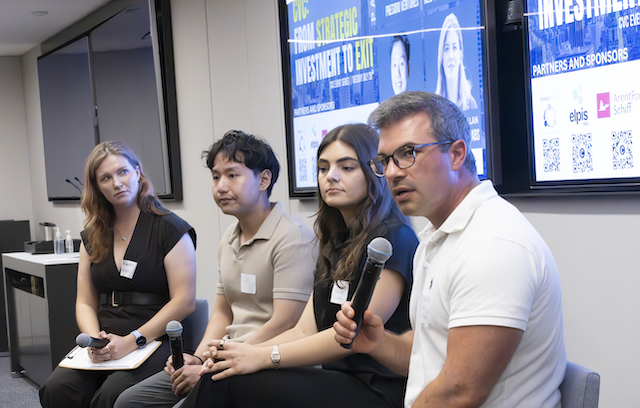
Investors from Presidio Ventures, New York Life Ventures, and Huntington Bank shared insights on how startups can turn strategic capital into global growth at The Vertical’s recent event.
CVC can be a gateway to international markets
Tyler Schinto, CFA, Senior Director at Presidio Ventures, described the model behind the venture arm of Japanese conglomerate Sumitomo Corporation, which operates more than 900 companies across approximately 70 countries.
Presidio Ventures was originally established to identify emerging companies that could eventually become commercial partners for Sumitomo.
“We invest in emerging growth companies that could benefit from Sumitomo’s network, ecosystem, and all of their other subsidiaries, either as supplier, as go-to-market partner, distribution partner, not only in Japan, Asia Pacific, but worldwide,” Schinto explained.
One of the clearest examples is Dexterity, a warehouse automation company in which Presidio invested at the Series B stage. At the time, there was no obvious international opportunity for Sumitomo to support.
Several years later, Dexterity began exploring the Japanese market. Sumitomo’s logistics group introduced the company to one of Japan’s largest logistics companies. The relationship led to the creation of a joint venture and $95 million in new funding, bringing the startup’s total valuation to $1.65 billion.

For a startup that has established itself domestically and is preparing to expand into another developed market, having a strategic investor with international reach can demonstrate that the company is ready for its next stage of growth.
“Sometimes they’ll bring Sumitomo because it signals, ‘Okay, this company’s ready for an international expansion,’” he said.
For international founders, that can be especially valuable when entering a market where they lack established relationships.
Strategic capital is not always about immediate business
The panel also highlighted an important misconception about CVC: strategic investment does not always mean a corporate investor will immediately become a customer.

Madison Cuthbertson, investor at New York Life Ventures, said the fund is roughly “50-50 financial return driven and strategic partnership driven.”
The two relationships, however, are not dependent on each other.
“We don’t have to partner with the business to invest in them and we don’t necessarily have to invest in that business in order to partner with them,” Cuthbertson said.
That means founders should not assume that a corporate investor will only invest if a specific business unit is ready to sign a contract.
For other CVCs, the model is more explicitly strategic. Leo Lu, who is responsible for partnerships at Huntington Bank, explained that any investment made by Huntington Ventures must have a partnership component attached to it.
What founders should know before approaching a CVC
The panelists emphasized that founders should do their homework before approaching a corporate venture fund.
Schinto’s advice was straightforward: understand the corporation first.
“We’re a large organization, we’re highly diversified. Ten years, 15 years into it, I’m still learning about different businesses that Sumitomo’s involved with,” he said. “Founders should research where a corporation has pain points and where their technology could create value.”
He also recommended approaching a CVC through an existing venture capital relationship when possible.

For Lu, the key is understanding what the corporate venture team can do. The CVC may be able to make an investment and connect a startup with the right people, but the ultimate commercial decision may sit with a separate business unit.
“The CVC is really that connected tissue between that,” Lu said.
CVC works best as a long-term relationship
The discussion ultimately pointed to a broader lesson for founders: the value of corporate venture capital is rarely limited to the investment itself.
A corporate relationship can evolve from investment to customer, market-entry partnership or, eventually, an acquisition.
For companies building global businesses, that long-term perspective can make CVC particularly attractive.
DISCLAIMER.
The Vertical’s “CVC: From Strategic Investment to Exit” was sponsored by LARION, a leading AI and IT outsourcing company, ArentFox Schiff, a top law firm, and Trinovation Partners, a growth and innovation partner to venture-backed companies.