Corporate venture capital has become a major force in startup financing, participating in nearly one in four venture deals globally. Yet for many founders, particularly those entering the U.S. market from abroad, it remains one of the least understood parts of the innovation ecosystem.
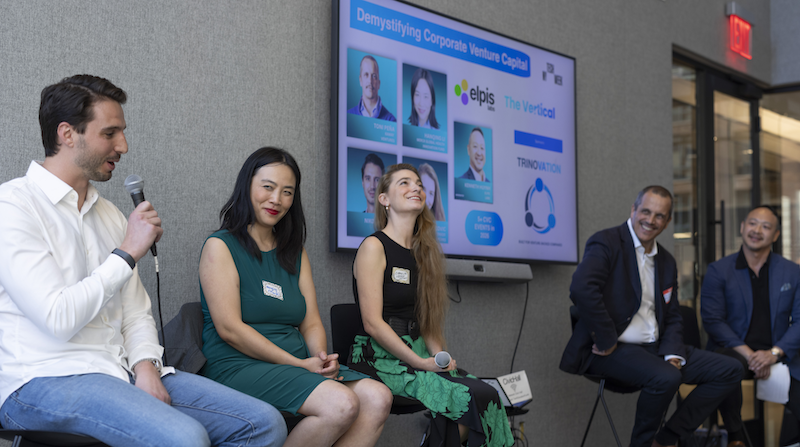
To help bridge that gap, The Vertical and Elpis Labs launched a new event series during Tech Week NYC, bringing together corporate investors and high-growth founders for a discussion on how CVCs evaluate startups and create strategic value.

The inaugural panel, moderated by Elpis Labs Managing Partner Kenneth Huynh, featured Hanqing Li, Investment Director at Merck Global Health Innovation Fund; Coppelia Marincovic, Partner at Syensqo Ventures; Toni Peña, Managing Partner at Kamay Ventures; and Niko Koenning, Principal at Cigna Ventures.
While each fund represented a different industry, geography, and investment model, a clear theme emerged throughout the evening: founders who view CVCs solely as sources of capital are missing the bigger opportunity.
Strategic value comes before capital
One of the most common misconceptions among entrepreneurs is that corporate venture funds evaluate startups the same way traditional VCs do. The panelists repeatedly emphasized that while financial returns matter, strategic alignment often determines whether a deal moves forward.

“We’re financial and strategic,” said Marincovic. “We need to be able to express what the synergies are between the startup and the corporate when we make an investment.”
For corporate investors, that can mean access to new technologies, research acceleration, market expansion opportunities, or solutions to internal business challenges. The startup’s ability to articulate that value is often as important as its growth metrics.
Koenning explained that at Cigna Ventures, investment decisions are closely tied to enterprise priorities.
“The executive leadership team understands the strategic value we’re bringing by making investments,” he said. “We spend a ton of time during diligence really understanding what strategic value we’re creating through an investment.”
For founders, that means the pitch cannot stop at market size and revenue projections. It must also answer a simpler question: why does this matter to the corporation?
Corporate investors want more than a customer relationship
Unlike traditional venture funds, CVCs sit inside large operating businesses. As a result, successful relationships often extend far beyond the investment itself.

Toni Peña, whose Kamay Ventures works with corporate partners including Coca-Cola and Grupo Bimbo across Latin America, described this as one of the biggest advantages founders often overlook.
“The most important thing for us is not the money,” Peña said. “It’s helping startups work with corporations to grow their business.”
Kamay has facilitated around 130 proof-of-concepts with startups and corporate partners, creating pathways for founders to access customers, distribution networks, and industry expertise that would otherwise take years to build independently.
For international entrepreneurs entering unfamiliar markets, those relationships can be especially valuable. Access to a corporation’s customer base, procurement teams, business units, and internal champions can accelerate market entry far faster than a fundraising round alone.
Research matters more than ever
Another recurring message from the panel was that founders must do their homework before reaching out.
Corporate investors receive countless decks each week, many of which demonstrate little understanding of the corporation’s priorities or business challenges.
“I think you can really see the difference between people who send a very generic deck and people who have done their research,” Marincovic said. “If you do your research and understand where the synergies are, you have a much better chance of getting through the filter.”
Hanqing Li echoed that view. “Know your audience,” she said. “What areas are they active in? What does their pipeline look like? Come from a place of understanding how you can help them solve a problem.”

The advice was particularly relevant for international founders seeking to enter the U.S. market, where corporate organizations can be complex and highly specialized.
Understanding which business unit, innovation team, or venture group owns a particular challenge can dramatically improve the chances of securing a meaningful conversation.
Relationships should start long before you need capital
Perhaps the strongest consensus among the panelists was that founders should engage with corporate venture funds much earlier than they think.
“We like to see things very early,” said Marincovic. “Often it’s too early, but we start the conversation and the relationship matures over time.”
Koenning agreed, encouraging founders to begin building relationships even before they are actively fundraising.
“Start building relationships with CVCs really early,” he said. “Something that was irrelevant three months ago can be totally relevant today. If you’ve already built that relationship, we’re much more likely to reach back out.”

For founders navigating long enterprise sales cycles, changing corporate priorities, and increasingly competitive fundraising markets, those early connections can become a significant strategic advantage.
A new bridge between corporates and global founders
As corporate venture capital continues to expand globally, understanding how these investors think is becoming increasingly important for founders seeking scale.
The discussion highlighted that successful CVC engagement is rarely about sending more pitch decks. Instead, it requires understanding corporate priorities, identifying strategic alignment, building relationships early, and demonstrating tangible business value.
For international entrepreneurs, that process can often feel opaque. The goal of the new event series from The Vertical and Elpis Labs is to make those pathways more visible.
Demystifying Corporate Venture Capital #NYTechWeek edition was sponsored by Trinovation Partners — AI Data Operations & Startup Scaling.